

England's New Landlord Register: Renters' Rights Act 2025 Registration Rules and Deadlines

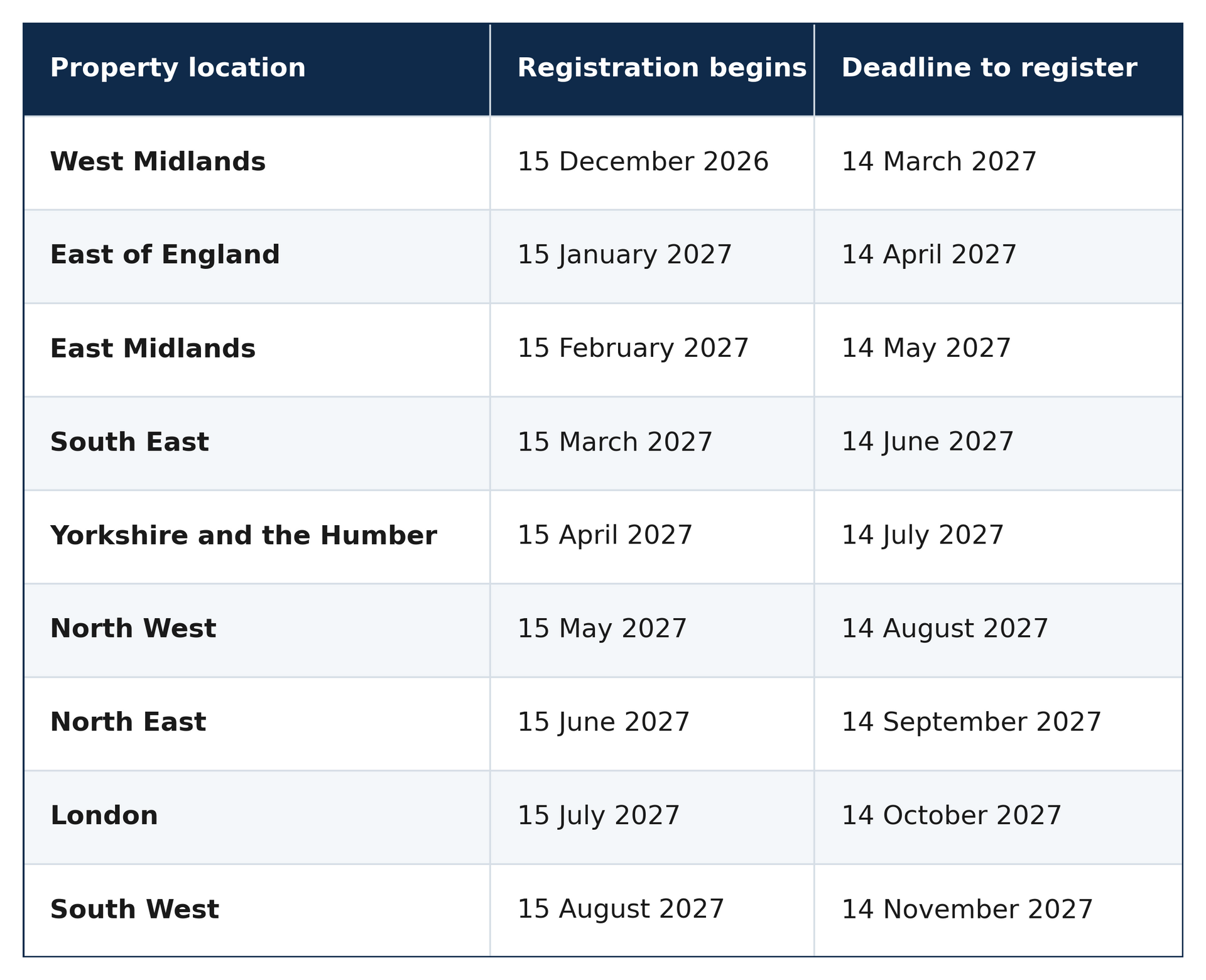
The Government has confirmed that its new national landlord and rental property register will begin rolling out across England from 15 December 2026.
Officially called the "Register your rental property" service, the register is being introduced under the Renters' Rights Act 2025. Most private landlords will eventually be required to register themselves and each property they let.
The system will be introduced region by region, so landlords and letting agents must check the deadline that applies to the location of the property, rather than the landlord's home or business address.
At a Glance:
- Registration opens region by region from 15 December 2026
- Landlords must register themselves and each property, and pay an annual £65 fee per property
- Local authority penalties for non-compliance run up to £40,000
- Registration may affect a landlord's ability to obtain a possession order
Requirements of the New Landlord Register
The new requirements will initially apply to properties that are already let, or which become let during the regional rollout.
Landlords will be required to:
- register themselves and each relevant rental property;
- pay an annual fee of £65 for each property;
- renew each property's registration every year;
- provide information about the landlord, property, tenancy and rent; and
- provide details of important compliance documents, including gas, electrical and energy performance certificates.
The fee will be adjusted during the rollout so that landlords registering in the earlier regions are not unfairly charged more.
The service applies to England. It does not replace the separate landlord registration and licensing requirements that already operate in Wales through Rent Smart Wales.
Your Regional Registration Road Map and Deadlines
Registering a Multi-Region Portfolio Early
Landlords will have a three-month registration window for their region. However, properties in other regions may be registered early from 15 December 2026, making it easier for landlords with properties across several parts of England to deal with their whole portfolio together.
Unoccupied and Unlet Properties
During the initial rollout, unoccupied properties do not need to be registered. The Government intends to introduce a later requirement for properties to be registered before they are marketed for letting.
Who Needs to Register for the New Landlord Register?
The requirement will generally apply to private landlords of assured tenancies and regulated tenancies in England.
Supported exempt accommodation is excluded from the initial requirements. Certain arrangements falling outside the assured tenancy regime may also sit outside the register, but landlords should not assume that an agreement is exempt simply because it is described as a licence, company let or other non-standard arrangement.
Jointly Owned, Company and Trust-Owned Properties
Where a property is jointly owned, each landlord will need their own landlord entry, although there will only be one property entry.
Landlords operating through a company, trust or charity will need to provide information about the organisation and the person registering on its behalf.
What Information Will Landlords Need to Provide?
Landlords should expect to provide:
- their name and contact details;
- the identity of the legal owner;
- the property address and ownership type;
- the type and size of the property;
- the number of occupants and households;
- the rent and payment frequency;
- details of any property licence;
- gas safety information;
- an EICR or relevant electrical certificate; and
- EPC and energy-efficiency information.
The draft regulations also provide for information to be kept current. Landlords should therefore expect to update the register when matters such as the rent, occupancy details or safety certificates change.
Can a Letting Agent Complete the Registration on a Landlord's Behalf?
Agents will be able to assist, but landlords cannot hand over the entire responsibility.
The landlord must start and complete the registration process. An agent or property manager may be authorised to provide certain information, but the landlord remains responsible for ensuring that the required information is complete and accurate.
This means agents should begin discussing registration arrangements with their landlord clients now. Terms of business may also need to be reviewed so that responsibilities for gathering information, uploading documents, monitoring changes and completing renewals are clearly recorded.
What About Property Advertising Requirements?
The Government intends to require landlords and letting agents to include the landlord and property registration numbers in rental advertisements. However, this obligation will be brought into force later, alongside the public-facing part of the service; it does not begin automatically on 15 December 2026. Further guidance and legislation are expected before this requirement takes effect.
Once implemented, agents and advertising platforms will need systems to verify that the relevant entries are active before a property is marketed.
What Happens If a Landlord Does Not Register?
Failure to comply should not be treated as a minor administrative oversight.
Civil Penalties and Prosecution
Local authorities will have enforcement powers, including civil penalties of up to £7,000 for relevant breaches. More serious or repeated offending, and knowingly or recklessly providing materially false or misleading information, may result in prosecution or a civil penalty of up to £40,000.
Impact on Possession Orders
A landlord who is in breach may also be prevented from obtaining a possession order on most statutory grounds until the required entries are active. The limited exceptions relate to serious criminal or anti-social behaviour grounds.
What Should Landlords and Agents Do Now?
Landlords and agents should:
- divide their portfolios by region and record the applicable deadlines;
- confirm the correct legal owner of every property;
- identify jointly owned, company-owned and trust-owned properties;
- check that gas, electrical, EPC and licensing records are complete;
- agree who will gather and upload the required information;
- budget for the annual £65 fee for each property; and
- create a system for monitoring changes and annual renewals.
The register is not yet open, but preparation should begin now. Landlords with incomplete records or uncertain ownership and compliance arrangements may find that registration exposes wider problems that need to be addressed.
Further information is available in the Government's official registration guidance and the Renters' Rights Act 2025.
Get Help Preparing for the New Landlord Register
Zoe Turner and Woodstock Legal Services can help landlords and letting agents prepare for the new registration requirements, review portfolio compliance, and address issues that could affect future possession proceedings. Get in touch with our award-winning Landlord & Tenant team by completing the form below.

Contact Us
News & Insights