
Wildfire Britain: Who is Liable When the Flames Spread to Your Property?
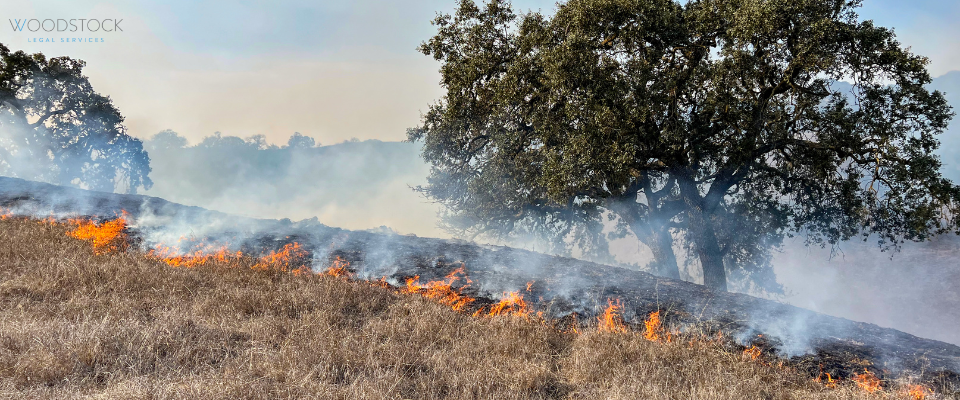
The UK has seen an unprecedented number of grass and wildfires during recent periods of exceptionally dry weather, with mountainsides and grasslands burning, homes and businesses being placed at risk, and significant emergency resources being required to bring some of the most serious fires under control. As wildfires become more frequent, questions of wildfire liability, and who is legally responsible for the resulting property damage, are becoming increasingly common.
For Zoe Turner, our property and Landlord & Tenant solicitor who lives in Wales, this has felt particularly close to home, having watched the mountain she grew up on burn while the Army was brought in to assist with containing the fire. Alongside the larger wildfires attracting national attention, there has also been an increase in enquiries from property owners who have suffered substantial losses because a fire started by somebody else has escaped and spread onto their land.
In some cases, the consequences have been devastating, particularly where an apparently ordinary activity has resulted in a fire spreading far beyond anything the person responsible could have anticipated.
One incident in Wales reportedly began when charcoal from a barbecue, believed to have been extinguished, was disposed of onto land behind a property. The charcoal had not completely gone out and, with the surrounding grass exceptionally dry, a fire started and spread rapidly, ultimately destroying three homes and leaving people homeless.
There was never any intention to destroy those properties or cause anybody harm, but once the fire was extinguished and the extent of the damage became apparent, a very different question arose: who should ultimately be liable for the financial consequences?
When Does an Accident Become Negligence?
There is an understandable assumption that where a fire is described as accidental, nobody can be legally responsible for the damage it causes, although the legal position is considerably more nuanced.
Negligence does not require somebody to have intended to cause damage. Instead, consideration is given to whether reasonable care was taken in the circumstances, whether the risk of the fire spreading was reasonably foreseeable and whether a failure to take reasonable precautions caused the resulting loss.
The circumstances surrounding the fire will therefore be central to any claim. Dry weather, strong winds, the condition of surrounding vegetation, the amount and nature of material being burned, the proximity of neighbouring homes or buildings and the precautions taken to contain or extinguish the fire may all be relevant when considering whether reasonable care was exercised.
A person may genuinely have believed that a fire was safe or that charcoal had been extinguished, but that belief will not necessarily determine the legal position if the circumstances were such that a reasonable person should have appreciated that there remained a risk of fire and taken further precautions.
The question is therefore less about whether somebody meant for the damage to happen, because in most cases they plainly did not and more about whether the risk should reasonably have been appreciated and whether sufficient steps were taken to prevent it.
What Happens When Controlled Burning Gets Out of Control?
The same considerations can arise where somebody deliberately undertakes controlled burning or lights a bonfire which subsequently escapes.
There may have been every intention to manage the fire safely, and no intention whatsoever for it to leave the land on which it was started, but a controlled fire can become uncontrolled remarkably quickly, particularly where the surrounding land is exceptionally dry, or weather conditions change.
Where somebody chooses to undertake controlled burning, questions may arise as to whether the conditions were suitable, whether the amount and nature of the material being burned created an increased risk, whether neighbouring land or property was sufficiently close to be endangered and whether adequate precautions were available should the fire begin to spread.
The fact that the eventual damage was unintended does not, by itself, prevent a negligence claim if the evidence establishes that reasonable precautions were not taken and that failure caused damage to somebody else's property.
Does a Fire Starting on Someone's Land Automatically Make Them Liable?
The position also needs to be considered from the other side too because the mere fact that a fire started on somebody's land and subsequently crossed a boundary does not automatically make that person liable for everything damaged in its path.
A claimant will need evidence establishing how the fire started, who was responsible for the activity which caused it, what that person did or failed to do and how those actions resulted in the damage being claimed.
Fire and Rescue Service reports can be incredibly valuable in establishing those facts, as they may record the source of ignition, the suspected cause of the fire, weather conditions, the material involved and factors which contributed to its spread. Photographs, videos, witness evidence and correspondence with insurers or loss adjusters may also help to establish what happened while events are still relatively fresh.
The evidence gathered immediately following the fire can therefore become central to a claim months or even years later, particularly where the parties subsequently have very different recollections of how the fire started and whether reasonable precautions were taken.
Proving Property Damage After a Fire
Establishing negligence is only one part of a successful claim, because a property owner must also prove the financial loss actually suffered as a result of the fire.
Where a claim runs into tens of thousands of pounds, it will not ordinarily be enough simply to provide an overall figure for the property which has been destroyed. The losses will need to be properly particularised and supported by evidence, which may include photographs, receipts, invoices, valuations, repair costs and replacement quotations.
Insurance may meet some of the loss, with the insurer subsequently considering whether recovery can be pursued against the person responsible or their insurer. There may equally be significant uninsured losses which remain capable of being pursued, while in some cases the insurance policy may not respond to the particular loss at all.
This can leave a property owner who has already experienced the distress of a fire facing the additional difficulty of establishing precisely what has been lost and from whom those losses can potentially be recovered.
When a Fire Accident Has Serious Consequences
Perhaps the most difficult feature of these cases is that nobody may have intended any harm whatsoever, and the person who started the fire may themselves be devastated by what subsequently happened.
A barbecue, bonfire or controlled burn can begin as an entirely ordinary activity and, particularly during prolonged periods of exceptionally dry weather, develop into a serious fire which causes damage far beyond the property or land where it originated.
The legal question is therefore not simply whether the fire was accidental, but whether the person responsible should reasonably have foreseen the risk of it spreading, whether reasonable precautions were taken and whether any failure to do so caused somebody else's property to be damaged.
For property owners who find themselves on either side of one of these incidents, obtaining evidence at an early stage can make a considerable difference.
With hotter and drier periods making fires easier to start and considerably more difficult to contain, property damage arising from accidental fires and uncontrolled burning is becoming an issue seen with increasing frequency. Understanding wildfire liability, and knowing how to bring or defend a fire damage negligence claim, is therefore likely to become increasingly important for property owners across England and Wales. Get in touch with Consultant Solicitor Zoe Turner for specialist advice to protect your property via z.turner@woodstocklegalservices.co.uk or by completing the form below.

Contact Us
News & Insights